0 Items in Cart
Your cart is empty.
Browse Products
Ask an Expert
HVAC Sizing Calculators
Find the right system size in minutes — free, no signup needed.
Sign In
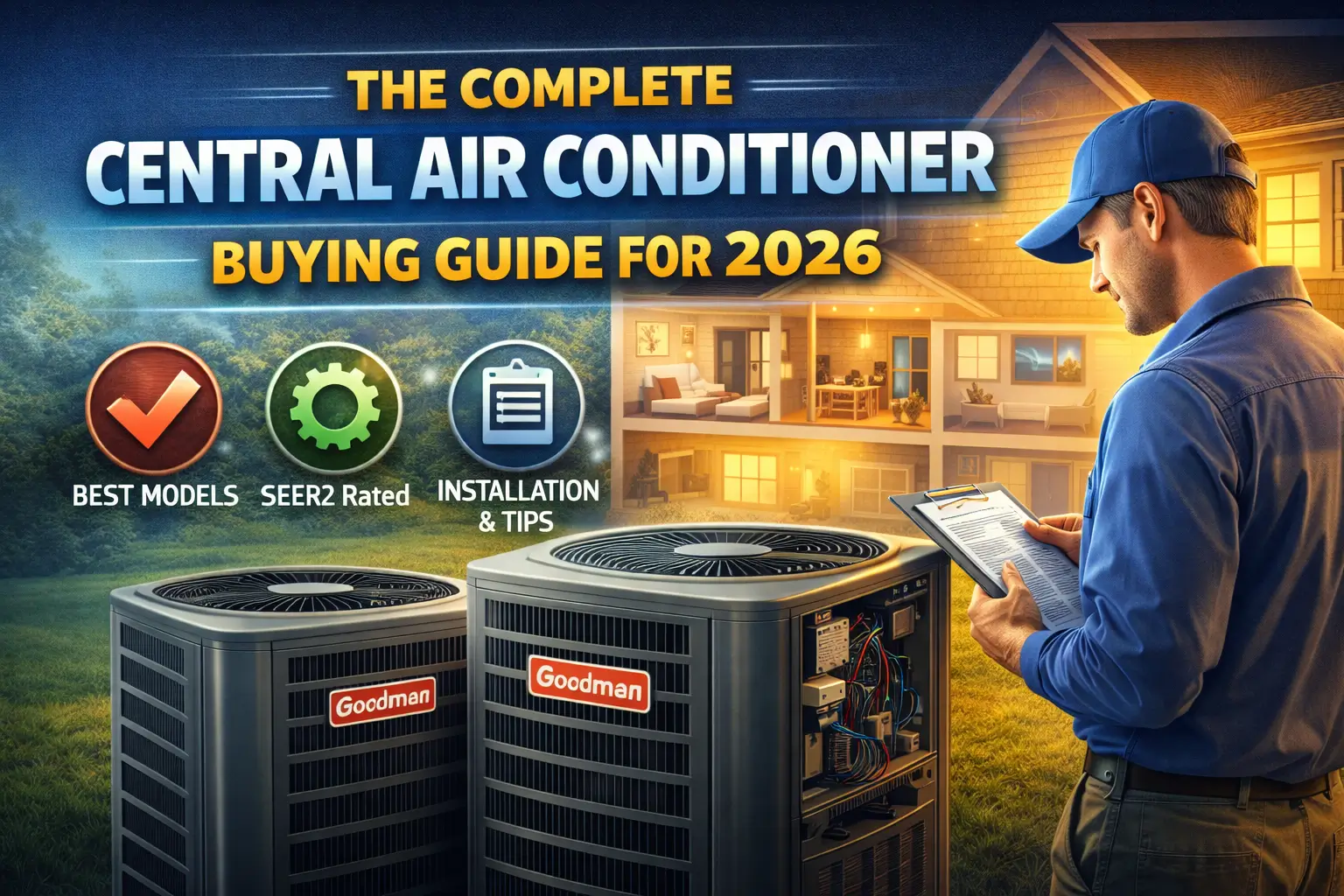
Replacing or installing a central air conditioner is one of the biggest investments you will make in your home. With new SEER2 efficiency standards now in full effect and refrigerant transitions underway, 2026 is a year where making an informed choice can save you thousands of dollars over the life of your system. This guide walks you through everything you need to know to choose the right central AC for your home, your climate, and your budget.
Quick takeaway: A properly sized, high-efficiency central AC can cut your cooling costs by 20–40% compared to a 10-year-old unit — and may qualify for federal tax credits up to $2,000.
A central air conditioning system uses a split design with two main components: an outdoor condensing unit that releases heat, and an indoor evaporator coil (typically mounted on your furnace or air handler) that absorbs heat from your home’s air. Refrigerant circulates between these two units through copper lines, and a blower pushes cooled air through your home’s ductwork.
The system is controlled by a thermostat, which signals the compressor to cycle on when indoor temperatures rise above your set point. Modern systems use variable-speed or two-stage compressors that run at lower speeds more often, resulting in better humidity control, quieter operation, and higher efficiency.
SEER2 (Seasonal Energy Efficiency Ratio 2) replaced the older SEER rating system and reflects more realistic testing conditions. A higher SEER2 number means greater efficiency and lower electricity bills. Here are the current minimums:
| Region | Split System < 45K BTU | Split System ≥ 45K BTU | Packaged System |
|---|---|---|---|
| North | 13.4 SEER2 | 13.4 SEER2 | 13.4 SEER2 |
| Southeast | 14.3 SEER2 | 13.8 SEER2 | 13.4 SEER2 |
| Southwest | 14.3 SEER2 | 13.8 SEER2 | 13.4 SEER2 |
For most homeowners, we recommend a SEER2 rating of 16 or higher. While the upfront cost is greater, the energy savings compound over 15–20 years of operation, and higher-efficiency systems typically qualify for federal tax credits and utility rebates.
Proper sizing is critical. An undersized unit will run constantly without adequately cooling your home, while an oversized unit will short-cycle, waste energy, and fail to remove humidity. AC capacity is measured in tons (1 ton = 12,000 BTU/hour).
| Home Size (sq ft) | Recommended Tonnage | BTU Output |
|---|---|---|
| 800 – 1,200 | 1.5 – 2 Tons | 18,000 – 24,000 |
| 1,200 – 1,600 | 2 – 2.5 Tons | 24,000 – 30,000 |
| 1,600 – 2,100 | 2.5 – 3 Tons | 30,000 – 36,000 |
| 2,100 – 2,600 | 3 – 3.5 Tons | 36,000 – 42,000 |
| 2,600 – 3,200 | 3.5 – 4 Tons | 42,000 – 48,000 |
| 3,200 – 3,800 | 4 – 5 Tons | 48,000 – 60,000 |
Important: These are rough estimates. Your actual sizing depends on insulation, window count, ceiling height, climate zone, and sun exposure. A Manual J load calculation is the gold standard for accurate sizing.
Central air conditioner costs vary based on tonnage, efficiency, brand, and installation complexity. Here is what you can expect:
| Tier | SEER2 Range | Equipment Cost | Installed Cost |
|---|---|---|---|
| Budget / Baseline | 13.4 – 15 SEER2 | $1,500 – $2,800 | $3,000 – $5,500 |
| Mid-Range | 16 – 18 SEER2 | $2,500 – $4,500 | $5,000 – $8,500 |
| Premium / High-Efficiency | 19 – 24+ SEER2 | $4,000 – $7,000 | $7,500 – $15,000 |
At National Air Warehouse, our wholesale pricing means you can save 20–40% on equipment costs compared to retail. When you buy the unit wholesale and hire a local contractor for installation, you keep more money in your pocket.
Single-Stage: Runs at 100% capacity every time it turns on. Least expensive but least efficient. Best for mild climates or tight budgets.
Two-Stage: Runs at a lower speed (~65% capacity) most of the time and ramps up to 100% only on the hottest days. Better humidity control, quieter, and 15–20% more efficient than single-stage.
Variable-Speed: Adjusts compressor speed continuously from about 25% to 100%. The most comfortable, quietest, and most efficient option — but also the most expensive. Ideal for extreme climates and homeowners who prioritize comfort.
Rheem offers a complete lineup from budget-friendly 14 SEER2 single-stage models to premium variable-speed units reaching 20+ SEER2. Known for reliable performance and competitive pricing, Rheem is an excellent choice for value-conscious buyers.
Bosch’s IDS series features inverter-driven compressor technology, delivering variable-speed performance with SEER2 ratings up to 20+. Bosch systems run exceptionally quietly and pair well with their matching air handlers for maximum efficiency.
Ameristar offers Trane-quality engineering at a more accessible price point. Their central AC units are ideal for contractors and builders who need reliable, no-frills cooling. Models range from 13.4 to 16 SEER2.
SEER2 rating: Match the efficiency rating to your climate and budget. Higher SEER2 saves more in hot climates.
Compressor type: Variable-speed compressors offer the best comfort and efficiency.
Air handler compatibility: Look for variable-speed blower motors, which distribute air more evenly and quietly.
Warranty: Longer is not always better — look at what is actually covered (compressor, parts, labor).
Smart thermostat compatibility: Modern systems integrate with Wi-Fi thermostats for smart scheduling and remote control.
Sound rating: Lower decibel ratings mean quieter outdoor operation. Under 72 dB is considered quiet.
The Inflation Reduction Act provides federal tax credits for high-efficiency HVAC equipment. For 2026, you may qualify for up to $2,000 in tax credits for qualifying central air conditioners that meet ENERGY STAR Most Efficient criteria (typically 17+ SEER2). Many state and utility programs offer additional rebates.
Pro tip: Check dsireusa.org for your state’s current rebate programs before you buy. Stacking federal tax credits with utility rebates can reduce your net cost by $1,000–$3,000.
Ductwork: If your existing ductwork is in poor condition, leaky, or improperly sized, even the best AC unit will underperform. Have your ducts inspected and sealed before or during installation.
Matching components: Choosing a matching indoor coil and air handler from the same brand ensures rated efficiency and warranty coverage.
Professional installation: Always hire a licensed, insured HVAC contractor. Ask for a Manual J load calculation before they recommend a system size.
Placement: The outdoor unit needs adequate clearance on all sides for airflow. Avoid placing it under decks or in enclosed spaces.
Have questions? Our HVAC experts are available by phone to help you choose the right system. We offer wholesale pricing, free shipping, and expert support on every order.
With proper maintenance, a central AC system lasts 15–20 years. Annual tune-ups, regular filter changes, and keeping the outdoor unit clean are the keys to maximizing lifespan.
Central AC installation requires handling refrigerant, which legally requires EPA 608 certification. We strongly recommend hiring a licensed HVAC professional for safe, warranty-preserving installation.
In hot, humid climates (Southeast, Southwest), aim for 16+ SEER2 to maximize savings. In northern climates with shorter cooling seasons, 14–16 SEER2 offers the best value.
If your furnace is over 15 years old, replacing both at the same time ensures matched efficiency, a single installation cost, and consistent warranty coverage.