0 Items in Cart
Your cart is empty.
Browse Products
Ask an Expert
HVAC Sizing Calculators
Find the right system size in minutes — free, no signup needed.
Sign In
If you are comparing HVAC spec sheets and one lists the motor in kilowatts while another uses horsepower, you are not alone in feeling confused. These two units measure the same thing, power, but they come from different measurement traditions. At National Air Warehouse, we regularly help homeowners decode equipment specifications to make confident purchasing decisions.
This guide covers the KW to HP conversion formula, provides practical charts for common HVAC motor sizes, and explains why understanding these numbers helps you choose more efficient equipment and manage energy costs.
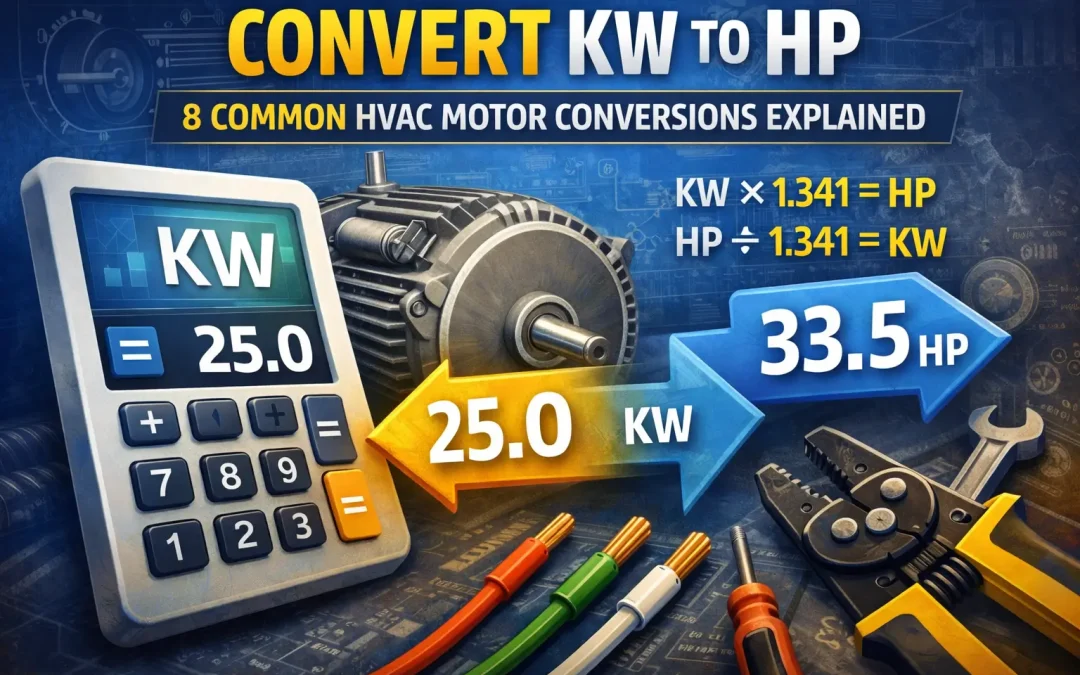
The conversion between kilowatts and horsepower is straightforward. One kilowatt equals approximately 1.341 horsepower. To convert KW to HP, multiply the kilowatt value by 1.341. To go the other direction, from HP to KW, multiply the horsepower value by 0.746.
In HVAC applications, kW typically refers to the electrical power the system draws from your home’s wiring, while HP describes the mechanical output of a motor like a compressor or blower fan. These numbers are related but not identical because motors are never 100 percent efficient. Some electrical energy is lost as heat during operation.
These values apply to standard electrical horsepower as defined by the Institute of Electrical and Electronics Engineers (IEEE). Always refer to the manufacturer’s specifications for exact ratings, as motor efficiency affects the relationship between electrical input (kW) and mechanical output (HP).
The kilowatt rating is the number that directly impacts your electricity bill. Your utility company charges by the kilowatt-hour (kWh), which equals one kilowatt of power used for one hour. If your HVAC system draws 3 kW and runs for 8 hours, that is 24 kWh of electricity consumed. At a national average of about $0.16 per kWh, that translates to roughly $3.84 per day or about $115 per month during cooling season.
Choosing a system with a lower kW draw for the same cooling output means choosing a more efficient system. This is where SEER2 ratings come in. A higher SEER2 system delivers the same cooling with less electrical consumption. Compare electric split systems and heat pump condensers to find the best efficiency for your budget.
The U.S. Energy Information Administration tracks electricity rates by state, helping you estimate costs based on local pricing. Regular HVAC maintenance also keeps your system running at peak efficiency, which translates to lower kW draw over time.
Myth: Higher HP always means better cooling. Reality: Cooling capacity is measured in BTU or tons, not HP. An efficient 2 HP system can outperform a less efficient 3 HP system in terms of cooling output per watt consumed.
Myth: You can ignore kW if HP is low. Reality: kW directly determines your electricity cost. Even a small motor running constantly (like a blower motor) adds up over months.
Myth: HP and kW are interchangeable terms. Reality: They measure power using different scales. HP is the imperial standard, kW is the metric standard. Both are valid, but kW is more directly useful for calculating operating costs. Understanding this distinction helps when comparing different HVAC systems.
When evaluating systems, look at both the capacity (BTU or tons) and the efficiency (SEER2 or EER). Together, these tell you how much cooling you get per kW consumed. National Air Warehouse carries equipment from top brands including Goodman, Rheem, and Bosch. Our energy efficiency blog provides seasonal tips for reducing operating costs.
Also consider surge protection for your outdoor unit. Power surges can damage compressor motors, leading to expensive repairs and increased energy consumption from degraded components. The National Fire Protection Association (NFPA) recommends whole-home surge protection for major appliances.
How do I convert KW to HP?
Multiply the kW value by 1.341. For example, 2 kW equals approximately 2.68 HP.
Which matters more for energy costs, HP or KW?
KW matters more for your electric bill. It directly measures how much electricity the system draws.
What is a typical kW draw for a residential air conditioner?
Residential systems typically draw 1.5 to 5 kW depending on size and efficiency. A 3-ton 16 SEER2 system draws about 3 kW under full load.
Can I reduce my HVAC system’s kW consumption?
Yes. Regular maintenance, clean filters, proper sizing, and upgrading to higher-efficiency equipment all reduce kW consumption. See our maintenance guide for specifics.
Where can I find energy-efficient HVAC equipment?
National Air Warehouse offers wholesale HVAC systems with competitive SEER2 ratings at wholesale prices. Call 888-292-0874 for expert guidance.